Showing posts with label rigging. Show all posts

Tuesday, March 25, 2014

Dyneema Rigging

When Zuline was launched she had beautiful hand spliced galvanised rigging. It was done by a very talented friend and it was very effective rigging. It was also very heavy - heavier than it needed to be.
Roll forward nearly 10 years. Zuline's mast was in sad need of some care and attention. She was launched in mid winter and it had been very difficult to get varnish to go off in the cold community hall where the mast had been. Consequently she was launched with only about 3 coats of varnish on the mast. We had chased the varnish for a number of years, just keeping ahead of it from a harness suspended from a halyard. A period of ill-health had put a stop to that and the mast had deteriorated.
We decided, after much agonising, to pull the mast out, strip the mast back to bare wood, make the minor repairs required and then get a decent cover of varnish on it.

On December 16 last year the mast came out, and it was a sorry sight. We set it up on trestles and got loose with the heat gun and scraper to remove the remaining varnish. It quickly became apparent that we might as well do a proper job and remove all the hardware as well. We needed help!! So we engaged a local shipwright to remove the hardware, do the minor repairs, sand the mast and prepare it for varnish. Once done Celia put 6 coats of Werdol Rapid Clear then 6 coats of Werdol Clear Varnish on both the mast and the boom. We are very impressed with this system so far. The Rapid Clear requires no sanding and only 5-6 hours between coats. So you get a quick build of product with lots of UV protection. Then the Clear Varnish requires sanding and 24 hours between coats. After this the spars looked glorious.

Meanwhile we had decided that all the near water stays (bobstay, whisker stays and boomkin stays) needed replacement. However we couldn't find anyone in Melbourne to splice them up in stainless. Eventually I tracked down Joe Henderson in Sydney who said "Put them in the post. We can splice them in galv, though I wouldn't recommend it, stainless or Dyneema." We settled on heat set Dyneema with overbraid.
Between Christmas and New Year we took a good hard look at the other stays and realised that whilst they mightn't all need immediate replacement they would soon enough. We took the tough decision to re-rig completely in Dyneema with overbraid. This was beginning to be a money pit. That's the problem with unexpected expenditure.
The thimbles were made on a CNC machine from Aluminium bronze with files provided by Joe

The Bobstay is 13mm Dyneema with Overbraid and served overall

Stays for a Lyle Hess 32 foot cutter

Whilst we were at it we embarked on a mission to remove anything hard or heavy that had been damaging the spars, particularly the bowsprit. As well the stainless lifelines gave way for new Dyneema ones.
The bronze piston hanks from the two headsails were quickly removed with a set of bolt cutters and replaced with our own design of Dyneema soft hanks.
The hanks were made from 2.5mm Dynex and are captive on the sail

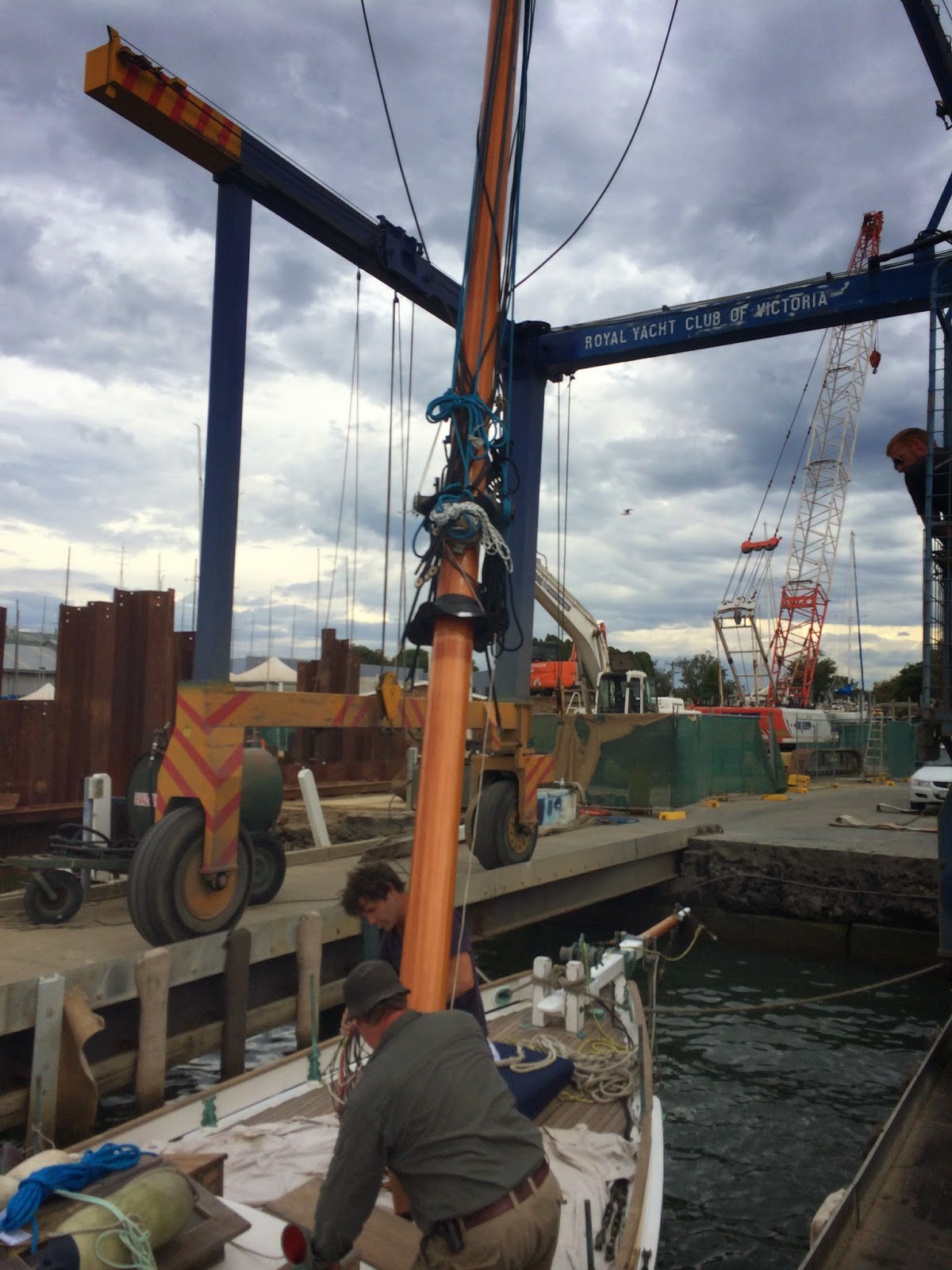
Finally the big day arrived and the mast was stepped. It was a great relief to have all the work come to fruition after almost 4 months out of the boat.
The end result is a different rig entirely. We removed 9kg of near water stays and 52kg of above deck stays. In their place we put back 3kg of near water stays and 13kg of above deck stays - and that includes the bronze bobbins. This represented a 74% saving in weight! Further weight reduction has come with the removal of the stainless lifelines, removal of stainless shackles and replacement with soft shackles, removal of reefing winches and a rethink of reefing...Overall the weight reduction is of the order of 70kg.
Joe Henderson was pleased with the outcome - and so are we. Joe had to remake only one stay on the day after launching and that was a quick and simple exercise. All the others fitted perfectly out of the box...and they look the part.
A happy rigger with his work

Now we just have to tackle the rest of the varnish. After the mast, that all looks quick and simple!

Thursday, February 11, 2010

Soft Shackles - Modern Art & Craft

If you look at a modern high tech racing boat you'll find exotic fibres sprinkled all over it. Boats are even using exotics in place of things like chain plates and fibre rigging is making a come back. All that makes tremendous sense when you are in a high tech racing campaign where every gram of weight counts and strength per unit size is ultra important.
What's that got to do with traditional wooden boats though? Well the answer is "everything and nothing"! My boat displaces about 8 tonnes on a 29 foot waterline - a lightweight flyer she isn't. However our spinnaker block is an Equiplite spectra block - it's very light and what's more important it won't damage the mast varnish by banging on it as a normal block would. It also has massive reserves of strength.
The spinnaker is a great big 840 square foot asymmetric. The thing about a traditional style boat is that it comes, ready made, with the bowsprit and all the trimmings to fly an asymmetric. Our J measurement is 18 feet on that 29 foot waterline so we can carry a big spinnaker with ease. The real purpose of that sail is for light winds - from basically 0 to 15 knots apparent. After that we feel like it belongs below. The apparent wind angles range from 50 to 130 degrees in light winds through to 65 degrees to 160 degrees at the higher end. But what we really like it for is light winds. With an asymmetric in order to sail deep you need to ease the tack line and get the luff of the sail to rotate out to windward. Again the heavier the pressure the deeper you can sail.
However at lower pressures you can still get good outcomes if you can get the weight out of the running rigging. The less weight the sail has to lift - either from the sheets or from the tack line and shackle the more likely it is to fill and set. So that sets us on a path to get the weight out of the gear and that's where exotics come in. We want sheets that are light, strong and which don't absorb water. There's nothing worse than having the sail collapse, the sheets getting wet and then making it hard for the sail to set again. So that means spectra sheets with the covers stripped or single braid spectra with a non-wettable cover added in the way of the winches.
Elsewhere on the boat we still want "hardware" that isn't hard on the boat. Lots of manufacturers are now offering soft "shackles". These are great - they weigh nothing and are very strong - but they are also very expensive. USD$90 for a shackle is too much for me.
My first attempts are in the photo below:
Top to bottom: 1 & 2 use a brummel eye splice and a double figure of eight stopper
3 uses a slip eye and double figure of eight
4 uses a slip eye and a carrick bend stopper
Each of these shackles is incredibly light and potentially incredibly strong. The breaking strain of the line is about 5,300 daN or about 5.3 tonnes. Subtract say 30% for the knot and then halve that for a safe working load and you still come up with a working load of around 1.85 tonnes (and yes I know that daN doesn't quite convert to tonnes but it's near enough). I say potentially because I haven't tested these yet. I'm waiting till I perfect them.
The one I really like is option 4: Options 1 and 2 rely on a fixed eye and whilst I think it is secure it could possibly be induced to work loose. Option 3 is OK but the lengths and tensions are not quite right. Option 4 is the best because not only are the tensions right but the slip eye is highly secure as you can see in the two close ups:

This photo clearly shows the slip eye. The braid is formed into an eye, one side of the eye is passed through the centre of the other side of the eye. It's then passed back out and the two ends formed into the carrick bend to form the stopper.
Under pressure the outer braid grips the inner braid and even at very low tensions it is impossible to either open or close the eye. To open the eye the outer braid is bunched slightly and the eye slid open.

The cover bunched and the eye slid open
Time to make one of these is about 15 minutes, materials cost about AUD$8.00. It's a bit hard to find a new shackle when one breaks half way across the ocean but it's easy and simple to make one of these.
Just to clear up a couple of misconceptions: Spectra/Dyneema has extremely good abrasion resistance and extremely good UV resistance. The spinnaker turning blocks on our boat are attached to the bulwarks with some strops made of this stuff. They've been out in the sun for about 3 years with no signs of any degradation and the only thing that's being abraded is the bulwark.
All I have to do now is to find a better way of finishing the carrick bend so that the ends don't show (any suggestions?) and then put a couple on a test rig.